
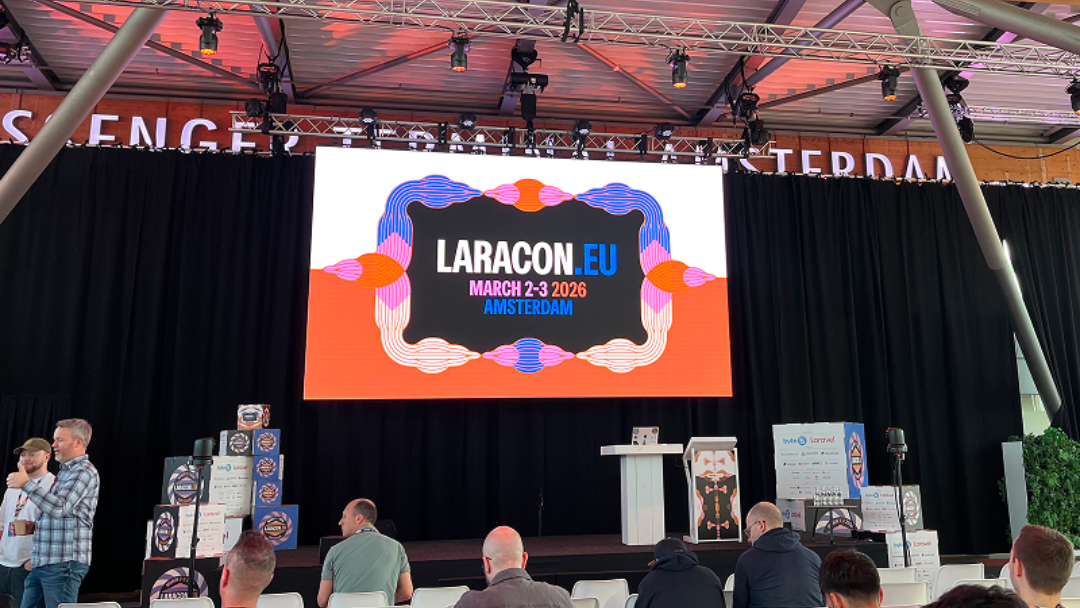
Laracon EU 2026: future-proofing with AI, agents and architecture

Pieter Mouton
Thursday 05 March 2026
This week, our team traveled from Ghent to Amsterdam to attend Laracon EU 2026 at the Passenger Terminal Amsterdam.
Attending events like this is essential to stay close to the technologies that power the digital products we build for our clients. Laravel plays a key role in many modern web platforms and the conference provided valuable insight into how the ecosystem is evolving, particularly with the rise of AI-driven and agent-based systems.
By engaging directly with the community and the creators behind the framework, we ensure that the solutions we design for our clients continue to be built on robust, forward-looking technology.
Here are our main highlights from two inspiring days.
Day 1: Clean code, big data, and the AI revolution
Building for the "Unhappy path"
Ryan Chandler opened with a vital reminder: build for exception cases as gracefully as you do for features. Staying consistent with error and validation handling across both front-end and back-end code is essential for a clean, professional codebase.
Modern CSS & High-Performance Databases
Leah Thompson showcased how new CSS features like the :has() selector and anchor positioning are replacing the need for custom JavaScript.
Later, Tobias Petry dived into TimescaleDB, explaining how compression and continuous aggregates can make querying "one billion rows" performant—expertise he gained while building the analytics tool Statdive.
Helping users overcome complexity with AI
Peter Suhm demonstrated how AI can drastically simplify complex UI/UX. Instead of forcing users through a complex multi-step "form builder," they can simply type: "Create a survey for Laracon EU 2026 with questions about the food and the speakers."
By using structured output, the AI generates the precise data format required by the backend, allowing the user to simply validate the result to validate what was being generated by generative AI.
This can also be applied to complex data filtering (e.g., "Show me all completed orders over €100") or even to automatically detect spam submissions in a list of contact form submissions.
The rise of NativePHP
Simon Hamp gave us an update on NativePHP, a project launched in the summer of 2025 that allows PHP developers to build native mobile applications. It compiles PHP code into a webview by default. Version 3.0 focuses on being flatter, faster and cleaner. It has also shifted toward a plugin system for native interactions like biometrics, camera, and file storage.
Refining the code review process
Luke Kuzmish discussed how code reviews remain critical in an AI age. We were pleased to see that many of Luke's recommendations align with our workflow at Endare:
Clear Traceability: Including ticket numbers directly in the Pull Request (PR) and using Jira integrations.
Self-Check: Reviewing our own code for obvious issues before assigning it to a designated reviewer.
Automated Tooling: Utilizing testing and linting to catch errors before a human even looks at the code.
Clear review feedback: At Endare, we further enhance this by using prefixes like REQ or PP in comments to distinguish between hard requirements and personal preferences.
Optimizing agentic coding
Yannick Kupferschmidt shared his inspiration from a year of using agentic tools at Byte5. Rather than warning against AI, he showed us how to achieve better results by providing clear, structured instructions (like claude.md) and exploring newer technologies like skills and MCPs (Model Context Protocol) to keep AI agents aligned with your specific coding style.
The Laravel Update: A glimpse into the future
Taylor Otwell closed Day 1 with a massive look at the ecosystem, specifically focusing on the new Laravel AI SDK (launching March 17th alongside Laravel 13). Built on top of PrismPHP, the SDK includes:
Text, Image, and Audio generation integrated natively into Laravel.
Embeddings and Rerank functionality for advanced similarity searches in vector databases.
The self-healing app (demo): Taylor demoed the most mind-blowing flow of the conference. An error in an application that got catched in Nightwatch triggered an AI-generated code fix PR. The fact that the code was automatically fixed by an agentic pipeline was already amazing. But while on stage, Taylor received a phone call from his personal OpenClaw assistant. The AI assistant told him a bugfix PR was ready and asked for permission to merge. Taylor simply said "Yes" over the phone, and the fix was merged to production instantly.
While this demo skipped traditional testing phases for dramatic effect, it perfectly illustrated the incredible power of automation and AI tooling for both coding and practical business applications.
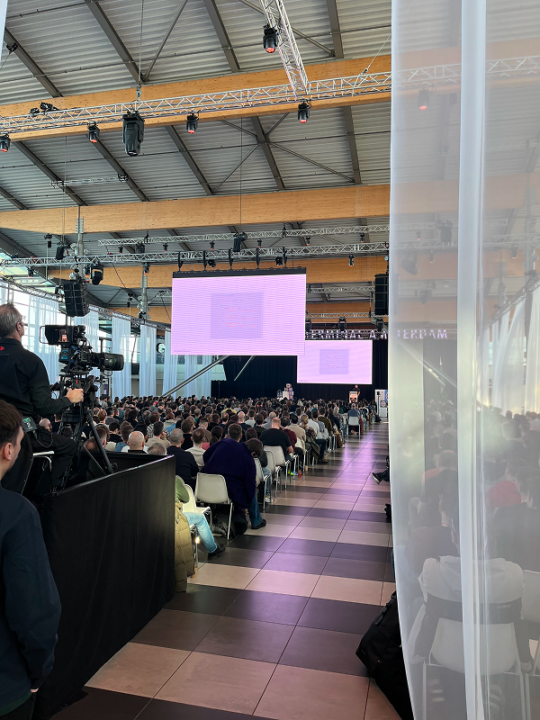
Day 2: Inertia v3, Modular Puzzles, and "Super Native" Speed
The future of Inertia
Joe Tannenbaum teased Inertia v3, which is slimmer and smarter. It now includes server-side rendering by default and introduces "optimistic" functions, allowing things like a "like" button to provide instant feedback without waiting for a server round-trip.
Architecture as a puzzle
Wendel Adriel compared building apps to puzzles. He advocated for invokable controllers and high type coverage to keep codebases "agent-friendly"—meaning AI tools can understand and navigate the code more effectively.
"Super Native" PHP vs. the competition
Shane Rosenthal revealed NativePHP "Super Native" mode, which renders native Kotlin or Swift code instead of using a webview.
The Technical Edge: Unlike React Native or Flutter, which require a complex JSI (JavaScript Interface) layer to bridge to C++, PHP is natively more aligned with C-based origins. This allows NativePHP to outperform competitors in tasks like JSON encoding/decoding because the "translation" layer is virtually non-existent.
UX and rapid deployment
Real-World UX: Pete Heslop argued that we should "onboard like restaurants" and "plan for failure like hospitals" to create more hospitable software.
Ship on Day 1: John Drexler discussed the importance of frequent deployments to solve hard problems early and gain customer trust.
Import War Stories: Daniel Coulbourne shared how to handle massive data imports from rate-limited APIs. One key strategy is prioritizing data that was recently updated, as it is statistically more likely to change again soon compared to stale records.
Parallel agentic coding
The final session by Marcel Pociot tackled the complexity of running multiple AI agents simultaneously. He introduced Polyscope, a promising new tool that uses GitHub worktrees to let multiple AI agents work on different tasks in parallel without concurrency issues.
Laracon EU 2026 was a powerful reminder that we are entering a new era of development. At Endare, we view AI as a massive opportunity to innovate on behalf of our clients. Whether it's simplifying complex interfaces or building self-healing systems, we are excited to implement these technologies in our day-to-day work.
Book a meeting
Discuss your idea directly with one of our experts. Pick a slot that fits your schedule!
Keep reading

One protocol. Every major AI vendor. Now what?
Every few months, a new acronym sweeps through enterprise AI conversations and lands on every executive's desk. This year it's MCP.

Thomas Van Duüren
AI should be the last layer you add
Many organisations start their digital roadmap with the same question: “What can we do with AI?” We believe this is the wrong starting point. Not because AI isn’t valuable but because AI is a multiplier, not a fix.
Thomas Van Duüren
Why most AI demos don’t scale
Every AI demo works perfectly. It has a smooth interface, fast responses, seamless and predictable outcomes. But what happens after the demo?
Thomas Van Duüren
